MORE OR LESS PERSONAL INFORMATION
The name "Keewatin" is an Ojibway word meaning "north wind."
The name "Dewdney" is from the French/Jewish name, "Dieudonne."
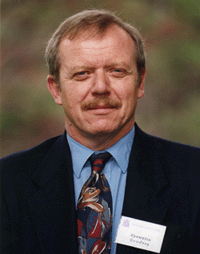
Contact Information:
Alexander Keewatin (A. K.) Dewdney
Former: Adjunct Professor
Dept. of Biology
University of Western Ontario
London, Ontario
CANADA N6A 5B7Associate Faculty
Centre for Environmental Science & Sustainability
University of Western Ontario
London, Ontario
CANADA N6A 5B7Full Professor
Dept. of Computer Science
University of Waterloo
Waterloo, Ontario
CANAD N2L 2G1Professor Emeritus
Dept. of Computer Science
University of Western Ontario
London, Ontario
N6A 5B7
Address: 42 Askin Street
London, Ontario
CANADA N6C 1E4
Telephone: Office (519) 679-8105
e-mail:
Literary agent: Linda McKnight
Westwood Creative Artists
94 Harboard Street
Toronto, Ontario M5S 1G6
Educational Background: Hon BSc Mathematics, University of Western Ontario 1964
MSC Mathematics, University of Waterloo 1965
PhD coursework, University of Michigan 1965-1968
PhD thesis and degree, University of Waterloo 1975
Research: I am currently engaged in an extensive research project involving abundances of populations in natural communities of living organisms. As revealed by an unusually large set of test data
involving 125 randomly selected biosurveys and a successful outcome of testing, a new species/abundance distribution called the J distribution (formerly the Logistic-J Distribution) outperforms
any of the dozen or so distributions proposed to date for this role in theoretical ecology.A book entitled The Stochastic Community [italics] has completed its third draft and is in the process of submission for publication.
Conservation: I am Chair of the Stewards Committee for Newport Forest, a property of the Thames-Talbot Land Trust. In this capacity, my wife Patricia and I not only oversee conservation activities on the property, but supervise an extensive All-taxa Biological Inventory (ATBI) on site which has just arrived at the 2000
species mark.This project follows a pilot study conducted by my wife Patricia and I at A'Nowaghi Forest Ponds under the supervision of the Kettle Creek Conservation Authority from 1996 to 1998.
Hobbies:
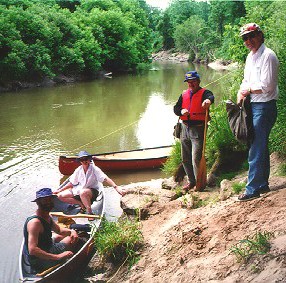
My wife and I enjoy canoeing down the many creeks and rivers of southern Ontario. We have a NovaCraft ultralight that weighs only 40 lbs. Here is a picture of early arrivals for a run down Otter Creek in 1995.
I learned to paddle a canoe from my father, who canoed extensively all his life and was an expert in canoeing and camping (voyageur style). He used the J-stroke, much favoured by sophisticated paddlers who wish to avoid the amateurish always-changing-sides stroke. Recently, however, I discovered a better stroke widely used by those native Americans who are heir to the ancient canoeing tradition. In the Ojibway stroke, you don’t twist the paddle at the end, you simply stroke with the blade (pitch) angle adjusted to give an outward kick throughout the stroke. It takes only a few seconds of paddling to get the pitch just right, sending the canoe forward in a straight line.
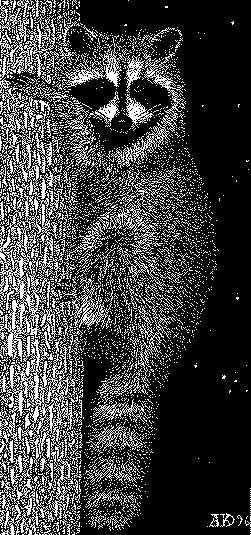
We love to observe animals in the wild, particularly mammals like the Raccoon, the Virginia Opossum and the Striped Skunk. We have raised several foundling raccoons and released them all - with largely unknown results.
We have spent many interesting hours watching animal behaviour at feeding stations, both in the wild and in our back garden in London, Ontario. Raccoons are especially interesting because of their near-prehensile abilities and clever brains that seem capable of dismantling nearly any mechanism made by humans. (It is high time that Canada ditched the rodent as its national symbol and turned to the raccoon. Let its ability to survive anywhere inspire us -- even if it means we only come out at night.)
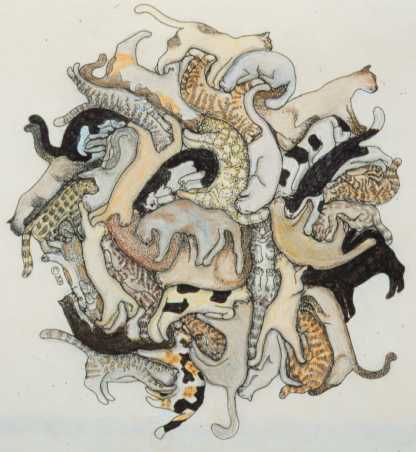
I enjoy drawing and sketching, having received a small amount of training from my father, who was an artist. Here, as an example of my “primitive” art, is an informal tessellation of cats. I think it would make a nice design for a quilt, each cat being stuffed to bas-relief, then stitched into place.